Authentically Being vs. Seeming in an AI Era
When intelligence can be simulated and communication can be generated, authenticity can no longer be read from the surface of things. It has to be located somewhere deeper.
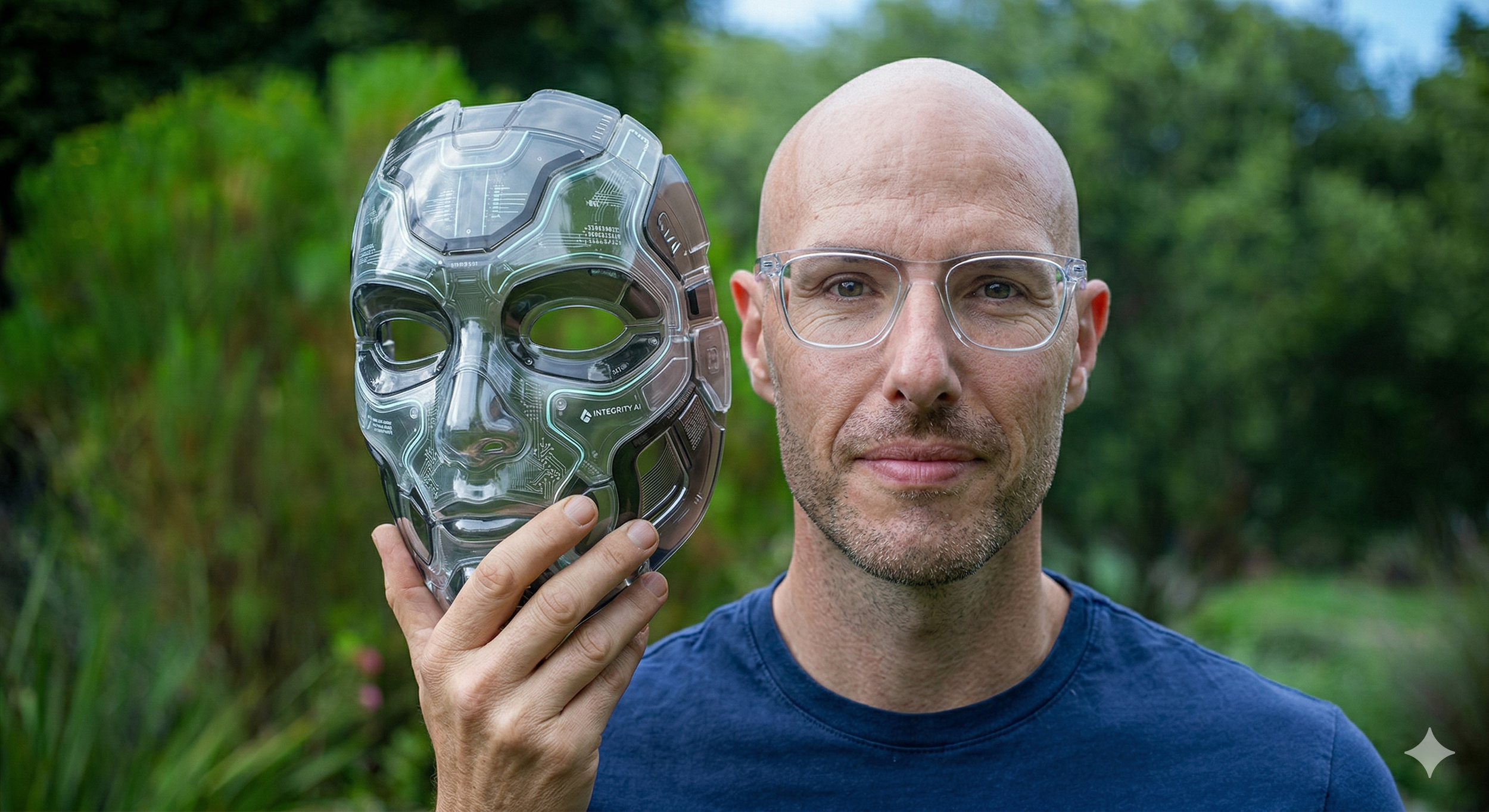
The deepest question that AI raises isn't "will it take our jobs?" It's something more unsettling: when intelligence can be simulated, what does it mean to be intelligent? And when communication can be generated, what does it mean to communicate authentically?
I was asked about this recently at the Craft Design Institute, where the conversation turned to what authenticity actually means in an age of artificiality. My answer surprised me a little as I said it out loud: authenticity isn't a stylistic approach. It's not the rough-cut video or the unedited voice note. Authenticity must be grounded in integrity. It is, at its core, about being what you appear to be.
Authenticity starts with clarity of intent — and it means staying within your resources, your budget, and your commitment to do what you say you are going to do.
If that means your videos come out rough because you are genuinely sharing work in progress, then that roughness is the authentic expression of what you're trying to communicate. But authenticity and polish aren't necessarily opposed. Depending on the integrity of the output, the most authentic approach might be a high-labour, high-touch process that results in something beautifully finished. The key is to bring being and seeming as close to each other as possible.
AI is, at its core, a seeming machine
AI produces outputs that have the appearance of understanding, care, creativity, and insight. The gap between being and seeming has never been wider, or more invisible.
This means the old surface markers of authenticity like a handwritten note, a rough video, the personal story are no longer reliable signals. They can all be generated. The aesthetic of authenticity has been decoupled from its source.
So if authenticity can no longer be read from the surface of a thing, it has to be found somewhere deeper. In the same place it has always actually lived: in integrity. In the alignment between what you are, what you intend, and what you produce.
Three questions that separate authentic from artificial intelligence
When working with AI, ask yourself
Who is accountable for the intent? AI can generate the words, but it cannot mean them. Authentic use of AI requires a human who genuinely holds the purpose behind the output — who would stand behind it if the AI were removed. The tool can amplify your intent. It cannot be your intent.
Who is doing the discernment? Polish produced by AI isn't inauthentic by default — but it becomes inauthentic when it bypasses judgment. The authentic intelligence in the loop is the person who decides what's true, what matters, what to cut, what to stand behind. If you can't edit the AI's output with taste and conviction, you're not really the author. You're a conduit.
Is there skin in the game? Authenticity involves commitment. Doing what you say you will do, within your actual resources. AI lowers the cost of output dramatically. But authenticity has always required cost: the cost of care, of choosing, of being willing to be wrong in your own voice. The question isn't whether you used AI. It's whether you were present in the result.
What the new authentic actually looks like
Perhaps authentic intelligence in an AI era looks something like this: being really clear about your goals and your values, and becoming better at delivering on them over time. In other words, it’s about trust and experience and results, not surface polish that can be easily replicated. Reputation will be more important than ever, detail and signals of real effort will be more important than ever.
What becomes inauthentic is using AI to simulate a self you haven't built, a depth you haven't earned, or a relationship you haven't cultivated.
AI can help you say what you mean better. It cannot help you mean something you don't.
And in a world where the surface of intelligence can be faked with increasing ease, the only thing that can't be faked is actually being there present, accountable, and willing to be seen as you are.