The Next Decade Belongs to People Who Redesign Their Jobs Now.
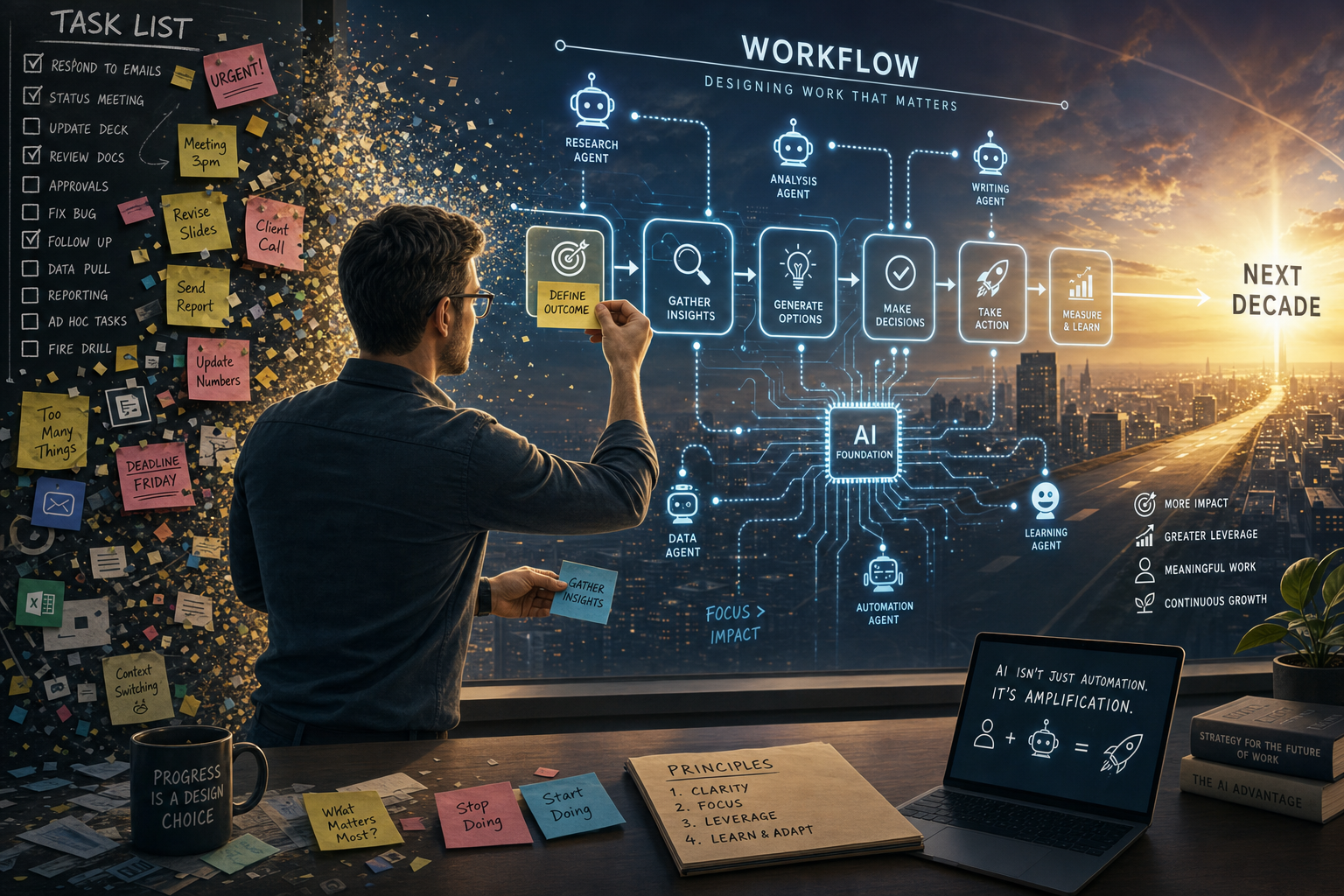
Most conversations about AI and work get stuck on the wrong question: “Will AI replace my job?” That question is too blunt to be useful. It treats a job as a single, indivisible thing, when in reality, every job is a bundle of smaller pieces.
If you want to stay useful in the age of AI, you need a more accurate lens. You are not defending a job title. You are redesigning a stack of tasks.
Jobs, tasks, and workflows
A job is not a single monolithic thing; it is a stack of tasks, and each task is a sequence of steps we call a workflow. AI is designed to take on tasks, not to own jobs. The strategic question therefore shifts from, “Will AI replace me?”
Which of my tasks should I hand over?
Which should I redesign?
Which should I personally keep?
Seen this way, jobs can and should change as workflows change. A “job title” has always just been a shorthand for a bundle of tasks that a human orchestrator is responsible for. When new tools appear, the bundle can be redesigned without dissolving the job itself.
Jobs Beyond Tasks
Consider the doorman at a luxury hotel. On paper, the job looks simple: open and close the door, a task that a sliding automated door can easily handle. But the real job is more complex:
Making guests feel welcome.
Conveying prestige and care.
Adding a visible layer of security.
Guiding lost visitors.
Spotting problems before they escalate.
When we reduce the job to its most mechanisable task, we strip out value. We have seen this in the sterile self‑checkout aisle in a supermarket: efficient, yes, but frustrating when the machine misreads an item, flags “unexpected item in bagging area”, or refuses alcohol sales to a legitimate adult. The apparent productivity gain hides a loss of reassurance, guidance, and problem‑solving that human staff used to provide.
The lesson is simple: if you define your job as a single task, you make it easy to automate and hard to defend. If you define it as a bundle of workflows that create real value, you have room to redesign.
Get radically clear on the value
The practical move is to get radically clear on the value you add at the level of tasks and workflows. For any job you care about, you can ask:
What outcomes does this job exist to create?
Which tasks inside it actually create those outcomes?
Which are mechanical, and which are deeply human?
As you find tasks that AI can take on, you do not simply hand them over and walk away. You take responsibility for managing that AI, improving its prompts and workflows, and making sure it serves the larger outcome well. That frees you to pick up the tasks that are uniquely yours to do.
In other words, you shift from being the person who performs every step to being the person who designs and directs how human and machine steps fit together. You become proactive about problem‑finding: looking for moments where the current workflow frustrates people, breaks trust, or leaves value uncaptured, and then redesigning the system so AI handles the mechanical work and you handle the human work.
The rise of the orchestrator
As AI absorbs the commodity middle of execution, the most valuable role in any organisation becomes the orchestrator. The orchestrator is not necessarily the most senior or most technical person in the room. They are the person who can:
Hold a project’s purpose clearly.
Design the AI workflows and agents that serve it.
Judge the machine’s output.
Take responsibility for the result.
Where most people use AI in one‑off chats that earn and then disappear, orchestrators build durable systems. They design workflows and agents that keep working long after the initial session ends, compounding capability into something like organisational “wealth” rather than just daily “income”. Their value lies less in how much they personally produce and more in how well they direct abundant intelligence toward outcomes that matter.
Crucially, orchestrators are fiercely protective of what is irreducibly human. They double down on connective labour: the relational, attentive work that builds trust and forms the real reason people pay other people in the first place. They read the room, understand the stakes, and design systems that deepen human connection instead of automating the humanity out of the interaction.
Owning the outcome
The shift from performing tasks to orchestrating outcomes ultimately comes down to decisional courage. AI can generate infinite options and process vast amounts of information, but it has no stake in the outcome and no ability to take the blame when things go wrong. It amplifies whatever judgment it is given; it does not supply judgment on its own.
In this landscape, AI provides the map, but you still have to drive the car. The real contribution is the willingness to say, “I made this call, and I own the outcome.” When you stop chasing every new AI tool and instead use the ones you have to serve clear, well‑designed workflows, you extend your agency, uncap your ambition, and move from being a task‑doer to an orchestrator of work that actually improves people’s lives.
The question, then, is no longer whether AI will take your job. It is whether you will step up to redesign the job as a stack of workflows, direct AI toward the tasks it does best, and claim the human work that is now more valuable than ever.